Posts

Cincinnati Art Museum

Over the last week, I had the opportunity to go the Cincinnati Art Museum not once, but twice.  My sister, brother-in-law and their two children were in town twice in a week.   The first visit -- I thought we would visit the Iris van Herpen: Transforming Fashion .  They have a section of the exhibit that allow the kids the ability to touch the clothes and see the fabulous exotic garments.  My nephew really liked talking about what they were made of and what they reminded him of.  The shoes (which I had missed the first time I went to the exhibit) were also a topic of much conversation.  He spoke about how tall they were, how difficult they would be to walk in, again, what they were made of.  He even pontificated on which ones he thought my mother/his grandmother would like best.   As you can suspect with a five year old in an art museum, he did get distracted eventually.  I remembered the children's room, which as I obviously h...

Detroit Institute of Art

Image
Over Thanksgiving, my family went to do a day in Detroit.  We started with a delicious lunch at Slow's and then headed over to the DIA to go to the joint special exhibit, Monet: Framing Life and Church: A Painter's Pilgrimage .   Monet really broke with tradition when he started painting in the outdoors.  It was really quite revolutionary.     I always enjoy learning about the relationships that the artists had with one another.  In the picture below, you can see Renoir painting Monet.  Monet also has many paintings of this exact garden and landscape. Renoir Monet After the Monet paintings, we went to the Church side of the exhibit.  I did not know much about Frederick Church before the exhibit.  It was interesting to learn about the trip he took with his family.  He took his wife and child on the trip across the middle east.  He did a number of sketches, paintings on site, but also did qui...

Nikko

Image
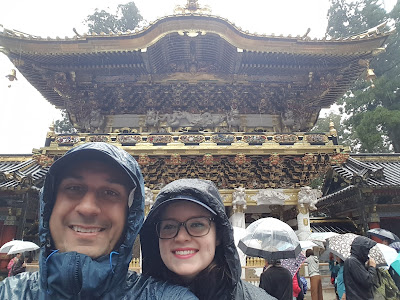
Jason and I knew that we wanted to do a day trip to Nikko from Tokyo.  Unfortunately, Nikko had rain in the forecast for every day we were in Tokyo.   To get there, it required that we took a shinkasen from the main train station and then get on a local train.  It turned out that the shinkasen we needed to take home was a major commuter option, so the original option we wanted was booked.  This is the only time we had any issues with booking the tickets we needed to.   I have bundled three temples that we visited into one larger post for simplicity.  We visited: Toshogu Taiyuinbyo Rinnoji We also visited the Kanmangafuchi Abyss. I will start with Toshogu as this was the largest draw to Nikko and also one of the most impressive things we saw while we were in Japan (and it had pretty serious competition).   Toshogu is the shrine and mausoleum dedicated to Tokugawa Ieyasu, the founder of the Tokugawa shogunate, ...

Naiku - Inner Shrine - Jingu

Image
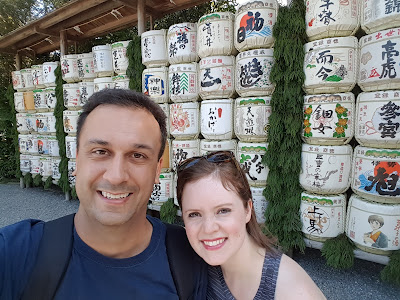
After we visited the Geku, we hopped on a bus to Naiku , also known as Ise-Jingu or simply Jinga.  All other Shinto shrines in Japan are known as XX Jingu,  This one is simple Jingu -- the ultimate. Like all great shrines, this one had a magnificent wall of sake barrels.   This ended up being the Christmas card photo! This shrine was even larger than the outer shrine and we spent quite some time wondering from shrine to shrine.  The bridge into the shrine was beautiful.  We wish we had known what the flags represented/said. From these photos, you can see the crowds of people at the main shrine.   We thoroughly enjoyed our time here.  It was something to see the most holiest place for Shintos. Time at shrine: 1.5 hr Times visited: 1 Overall: A-

Geku - outer shrine

Image
Our first stop in Ise was the Geku , or outer shrine of the Ise Shinto Shrine.  This is the second most sacred location.  We ended up with a gorgeous day although it did turn rather warm! This shrine is about a 15 minute walk from the Ise train station. I am going to cover a few things in this post that are also applicable to the Geku shrine.  The main shrine building gets rebuilt every twenty years with all new materials.  You can see next to the temple the place that it was before.  It has been rebuilt 62 times making the shrine 1240 years old, founded in 4 BCE.  No photographs are allowed within the area of the main shrine at both shrines.  The style of these two shrines is very different from the other shrines we visited -- they both were built pre-interaction with other cultures (like China and Korea).   The main shrine within Geku -- this was the closest photograph I could take All these structures get rebuilt every twenty ...

Futami-Okitama Shrine

Image
I knew when we were headed to the Ise Peninsula that I just had to get to the Futami-Okitama shrine as well!  It is the home of the "married rocks," a shrine to married couples and bliss.   We took a bus from the Inner Shrine, Naiku, to the shrine.  It was so easy -- only about a 15 minute bus ride.  We then caught the train back from here, so it was a really easy day and we covered a bit of ground. The rocks are really not that large -- probably only about 10-15 feet high.  Here is a picture with us in it for comparison This does seem to be one of the most famous spots in Japan at least for photographs.  It is definitely more challenging to get to them Miyajima, but maybe not by much.  From Kyoto, we got to Kyoto station and took a shinkasen.  We then transferred to a local train to end up at Ise (but we could have continued on the train to end up here).    Other than the rocks, this was a relatively quick visit!...

Fushimi Inari Taisha

Image
Okay, last post about Kyoto!  One of the most famous sights in Kyoto, even all of Japan is the Fushimi Inari Taisha . I recommend you click the link to see pictures of what the temple looks like when it is empty -- because it definitely will not look like that when you are there! This shrine is famous for the thousands of red torii gates that are on the property.  Each gate has a wish or prayer on it from local businesses. Inari is the shinto god of rice, very important to the Japanese with the fox being its messenger.  Thus this shrine has many statues of foxes, which tend to have red bibs on. I was surprised at how big this shrine was; I also had not realized that it did have quite a hike in the back.  We did a bit of one, but had not timed this visit well with lunch. Map of the grounds.  We got up about half way before the big circle starts   The torii gates are everywhere and all sizes.  It can cost up to 1M JPY to purchase one...